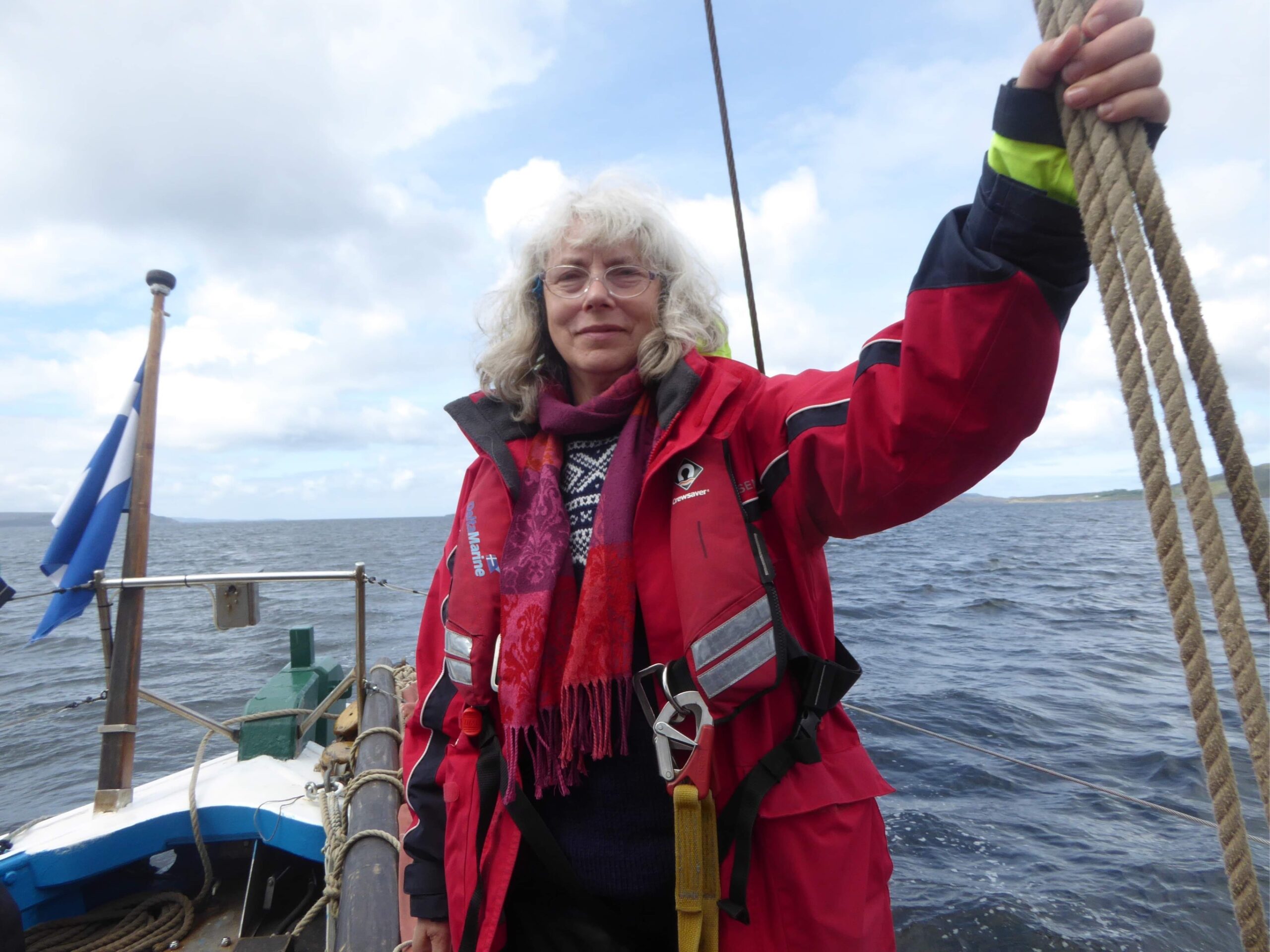
Today on Celtic Connexions, I’m welcoming back Marsali Taylor and her latest novel, Death in a Shetland Family.

Blurb
Shetland sailing sleuth Cass Lynch is definitely out of her comfort zone when she helps round up a prize-winning stallion escaped from the renowned Klaufister stud. She’s even less impressed by its owner, Keith Arthurson, a returned city slicker who’s already made enemies in his community.

Buy Links
PAPERBACK – https://www.amazon.co.uk/Death-Shetland-Family-Marsali-Taylor/dp/1035436272
KINDLE – https://www.amazon.co.uk/Death-Shetland-Family-Marsali-Taylor-ebook/dp/B0G3GZ59XW
Excerpt
Excerpt: from Chapter 4
In the end, it wasn’t too bad. We had four metres depth of channel and another metre of flooding tide, so we bisected the smooth water between the Green Point of Vementry and the Green Holm, passed the end of the three lines of mussel buoys, with the inevitable scarfs sitting on the top of them, and came in good order into the enclosed waters of Clousta Voe.
The houses were all round the South Voe. There was a cluster here, then the ruins of several stone-built houses along the headland, then another new house opposite, one of the big double ones, with picture windows looking out on a spectacular view seawards over the channel. A flock of coloured sheep watched with interest as we came past them.
Now we were chugging between cliffs towards Cloustaproper. The channel ended in a pool of water between grazed green hills with jagged lines of rock poking like bones through the cropped turf. A curve of houses ran along the shore and in a line up on the north hill, and every one of them had windows facing seawards. Suddenly I felt most horribly exposed. It was like we were about to park in somebody’s back garden. Every spyglass in the place would be on us as we ate our lunch. There were probably photos on Facebook already, asking who we were.
Unhelpfully, my larger-scale chart stopped at the north voe, but the smaller scale one showed a couple of isolated rocks on the outside of the little island. I looked at the depth gauge. We had four metres of water still, and there was a long bay to starboard, with only a couple of houses on it, and a rectangular floating pontoon stretching out from them. From my memory of the map, that had to be Klaufister. Twenty metres in there would take us behind the headland, where we could struggle with the geneker without having every retired seaman in the place saying how much better he’d have done it. After that, we’d eat lunch in this peaceful green corrie, then I was getting us out of here, back into safe waters.
We crept in cautiously, and dropped the lightweight kedge anchor on a short chain. I took a couple of meids, to make sure we weren’t drifting, then went below to dump my jacket and set the kettle on to boil. It was bonny, looking out through the windows at the shore: the sweep of green hill down to where it ended abruptly in the metre-high banks of the shore. There were geese on the hill, a great flock of them, maybe a hundred or more, and a clump of them on the water: one of the problems of warming temperatures. They no longer flew south, but overwintered here, and destroyed the grazing they colonised. There was an oilskin jacket and trousers hung on a scarecrow frame, but they were paying no attention to it.
A young woman came into view, walking from the house, a rope branks in one hand, a bucket swinging from the other. She called upwards, and a herd of horses came thundering over the hill, short legs going like pistons, manes flying. The geese scattered with alarmed honking and a rattle of wings. There was a black one leading the charge: Ebony. The woman put the bridle on him, then tipped a bucketful of tattie peelings in a line along the grass, and presided as they shoved each other to get at them.
The two houses of the map were diagonally in front of us. I peered ahead as I waited for the kettle to boil. Klaufister had been a bigger place once, and better cared for – though, I reminded myself, they’d had a tragedy here, and now they had one man gone, another not coping, and the wife injured and not yet able to look to things. There was a litter of blue plastic drums in a hollow on the shore, and bigger containers further up, orange and grey, in front of the ruins of an older, larger house, the length of two houses, with a substantial gable and most of the front still standing. A pile of rubble suggested someone was working on it, and the front was fenced, as if it was used to holdsheep and early lambs during the coldest weather. The nearest of the lived–in houses was a small cottage above the pontoon, a simple but-and-ben, in reasonable repair, but with flaking whitewash and a moss-spotted felt roof. I saw someone shift behind the glass, then move to stand by the window, looking out at us: a man. The son who drank? It didn’t look like a house with small children; there were no toddler toys around it, and no washing line of miniature onesies wafting in the light breeze – then I remembered Dad had said his wife had left him.
The second house, past the pontoon, was a newer build, and in better repair. It was square, with two windows in each side of it, a pitched roof running up to a short ridge from each wall, a felt roof, recently tarred. A trickle of smoke came from one chimney, and there was a peat stack by the door. Hens pecked around the short track leading down to the shore.
The kettle began to whistle. I brought the tea up, and went forward to see what had gone wrong with the geneker. We’d want it for going home again, so I was loathe to put it away altogether, but I could drop it, sort out whatever had snagged it, and secure it on the deck with bungees, ready to hoist again.
I uncleated the rope and began to drop the sail. I mustn’t have had a good enough grip on the rope, for it began to slither quicker than I meant, and before I knew it the heavy bronze furler at its head was hurtling downwards towards me. I ducked away from it, too late, and felt a hard blow on my head, then the guard rail caught the back of my legs and put me off balance, and then for what seemed like a long moment I was falling backwards, hands stretched back towards the boat, legs flailing in the air. I hit the water back on with a splash that echoed round the whole voe. I went under, scrabbled my way back up and trod water, gasping for breath. The cold hit me as the water seeped through my gansey. Above me, Anders was trying not to laugh as he threw down the end of one jib-sheet for me to catch. ‘What happened there?’
My head was spinning and for a moment I saw two ropes. I fumbled for the nearest one and let it take my weight. My best sailing boots were pulling me downwards, but I wasn’t going to kick them off unless I had to. ‘There’s a rope ladder in the aft locker, with a loop to go round the jib cleat.’
Anders moved quickly to hang it over the side while I sploshed over, the weight of the water making my movements uncoordinated. There were a couple of rungs below the water, and with the help of the jib-sheet wound round my hand, I managed to get one foot on the bottom one and shove myself unsteadily upwards until Anders grabbed under my oxters and hauled me over the guard rail. I sat down on the cockpit bench, dripping, and bent forwards to haul my boots off and tip the water out.
‘You’re bleeding,’ Anders said.
I put my hand up to my head. It came away red.
‘I’ll get a cloth,’ Anders said, and clattered below.
‘Hey!’ the woman onshore called, her voice carrying clearly over the water. ‘Are you okay?’
I turned around to look. She was only fifty metres away now, at the edge of the land, Ebony’s rope grasped with one hand, and older than I’d thought, twenty-six or seven, with short dark hair and dark eyes in a thin, tanned face. The movement brought a fresh gush of blood. I clapped my hand to it, and grasped the kitchen cloth Anders held out from the doorway. I pressed where it hurt and felt the blood trickling into it and dripping from my fingers. A red pool was forming on the light blue paint of my cockpit floor.
The woman gestured towards the jetty. ‘My mother’s a nurse. You could come and let her look at it.’
‘Heads always bleed,’ I called back. All the same, professional help was tempting. I could sit still in this wavering world and let her deal with it. ‘How deep is the water at your pontoon?’
‘Two metres.’
‘Two metres?’ Anders was looking ahead at the pontoon. It was a rectangle of walkway on orange floats, similar to the marina pontoons, and it would certainly hold Khalida in this wind, so long as it really had two metres of water, with another metre to flow in over the next three hours.Then he looked at my scarlet hand clutching the cloth to my brow, and went back for a basin of cold water, and another cloth.
I wrung the cloth out and pressed it to my head again.
‘If we can lie up at the pontoon there,’ he said, ‘it’d give us thinking space. I’ll start the engine and get the anchor up. You steer us in, I’ll leap about.’
I nodded, and wished I hadn’t. Sparks flashed in front of my eyes.
‘We’ll come in,’ Anders called to the woman. I sat quietly as Anders moved around me, giving me the occasional concerned glance. Within a minute he had the geneker bundled up and attached, the kedge on the foredeck beside it, and the engine running. I put her into gear and edged forward to the shifting pontoon, one eye on the depth. Four metres, three point eight, three point five, three, and we were there. I put the engine into reverse, then neutral, Khalida stopped obediently alongside, the woman caught her guard rail, and Anders leapt ashore, rope in hand, and tied her up.
I cut the engine and stood up, still clutching the cloth to my forehead. The woman put out a hand to help me onto the pontoon. ‘I’m Irene. Come you wi’ me. Mam’s joost in the house. We’re about to hae denner, if you fancy some soup.’
‘I wouldn’t say no,’ I said. I hadn’t felt cold while I was worrying about blood, but now my teeth were starting to chatter, and the land was swaying around me.
I felt the atmosphere of the house as soon as Irene led me in: a hard feeling of bitter unhappiness. The man had died in a car crash, the wife had been badly hurt, and the son who drank had been made worse. This Irene who was supporting me with such ready kindness must be one of the daughters. ‘Mam!’ she called, as we came through the door, ‘I’ve a patient for you.’
She helped me into a warm kitchen, a country kitchen with a Rayburn at the gable end, and a workmanlike wooden table below the window looking out on the voe. There was an armchair on the other side where her mother sat: a woman in her fifties, with a face lined with pain. I saw no resemblance to either of her children; her greying hair was neither Irene’s dark, nor Keith’s fair, but a mousy brown, and she had a low brow, a sharp chin and pale green-blue eyes. She wore a cherry-red yoke jumper which matched the patterned walking stick beside her, but whose bright colour drained her face. It was from her that the bitterness came; her face was sharp with it, her mouth set in angry lines, and it echoed in her voice as she greeted me. ‘Not only injured but wet through. Have you dry clothes aboard?’ Her hooded eyes had dark shadows under them, as if she didn’t sleep much.
I tried to think. Now I no longer lived aboard, I had a box with extra jerseys and gloves, but no spare jeans or thermals; I only took those aboard for longer trips, and right now most of my wardrobe was hanging out in the garden, drying. ‘Jerseys,’ I managed.
‘Well, let’s sort that first,’ the mother said. Her voice was low and soft, but with a sharp edge that made it a command. She nodded at Anders. ‘You’ll maybe go and get her two jerseys.’
‘Box by the engine,’I said. ‘Tupperware.’ He nodded and left.
‘Irene,’ the mother said, ‘go you into my bedroom and get out a towel, and my clean dressing gown from the press. Then you can help the lass get the wet stuff off, and while I’m looking to her head, you can find her dry clothes, and put her own in the washing machine.’ There was something mechanical about the way she spoke, as if she was determined to do her duty by this bleeding stranger thrust upon her. I felt mortified, but leaving now would only make it worse. I’d have to accept her kindness with grace, and pretend I didn’t see how reluctant it was.
‘I’m wearing thermals,’ I said. ‘They’ll dry quickly.’
Irene went out and upstairs, her footsteps clattering above us.
‘I’m Patsy,’ her mother said. ‘Patsy Arthurson. And you must be the lass that sails. My other son, Ertie, he works to your dad, driving plant.’ Her face twisted to anger. ‘Worked.’
‘Cass,’ I said. My hand was too bloodstained to hold out. ‘Cass Lynch.’
Irene hurried back down the stairs with a folded towel and a blue towelling dressing-gown. ‘This is my daughter, Irene,’ Patsy said. ‘Irene, this is Cass. Pass me that, and give her anhand wi’ those wet clothes, then get a bowl of water for her to wash.’
With Irene’s help, I managed to get most of my wet clothes off without making too much mess on the lino. The towel Irene held out was blissfully warm, and the dressing-gown covered me nicely. I tried to give Irene a hand picking up my clothes, but the room began to spin around, and I sat down abruptly. ‘Sorry,’ I said.
‘You just sit,’ Patsy said. ‘Irene can manage.’
It seemed that Irene was expected to manage everything. I sat in silence as she took my bundle of clothes into a side room. There was the click of a tumbler, a few bleeps, then running water as the machine cycle started. Irene came back in and stood quietly with her hands in front of her, looking at her mother for more instructions. For a moment I wondered if she had some kind of special needs, except that she’d been quick and clear when I’d had the accident. Maybe she’d had to bridle her tongue at first in patience as she ran after her injured mother, and had now got so used to her mother bossing her about from her chair that she no longer realised how extraordinary it was.
‘Now,’ Patsy said, ‘we’ll need a clean bowl o’ hot water, and cotton wool and the plasters box.’ Irene nodded, and went into a walk-in cupboard in the corner. ‘Sit you here,’ she added, and reached out a hand to drag a kitchen chair over to her. ‘In the light.’ She bent forward to inspect, still sitting in her chair. I closed my eyes. Her hands were assured, as she moved mine away, washed the wound and inspected it. ‘You’re given yourself a fair dunt. I doubt it needs stitching. Irene, gie the surgery a phone and explain. You can easy run her along to Bixter to get it looked at.’
‘We need to be out of here well before high water,’ I said. ‘Cribba Sound.’ I wasn’t negotiating the Icelanders and the Black Stane with this spinning head.
‘Yea, yea, plenty o time for that.’
She mopped away, then I heard the crackle of a plaster being unwrapped, and felt it being pressed to my brow. ‘There, that’ll do you for ee now. Steri-strip. Great stuff.’
I opened my eyes again. ‘Thanks. Thank you very much.’
She gestured towards the path. ‘And here’s your man back with your spare ganseys. Irene, keep him at the door while the lass gets dressed.’
‘Forty-five minutes,’ Irene said. ‘The doctor can see you at quarter to two.’ She went out to man the door, and I got into the clothes she’d brought. The t-shirt was Patsy’s, and hung off me; the pants and jeans were Irene’s, and I just managed to squeeze into them. ‘Three-quarters o’ an hour. Then there’s time for a bowl o’ soup,’ Patsy said. ‘Irene, let the young man in, then gieErtie a call for his lunch, and tell him we have visitors.’ She rose, levering herself up from her chair, and grasped her stick. ‘I was in an accident. You maybe kent.’
I nodded. ‘I heard.’ I wasn’t sure what to say, and resorted to formality. ‘I’m sorry for your loss.’
A wave of the former bitterness came back for a moment. ‘I told him he was no’ able to drive south, after all these years, but he widna listen.’ She stood for a moment, brooding, mouth hard, then took a step towards the Rayburn and lifted the lid of the pan. A most beautiful smell of tattie soup washed out in a cloud of steam.
‘I’m mending,’ she said. She nodded towards a pair of crutches in the corner past her chair. ‘I still need those occasionally. I’m mending slower than if I was your age, but I have the help o’ me bairns.’ A spasm crossed her face for a moment, as if she’d moved wrongly, and hurt something. ‘I’m out o’ the wheelchair, and mostly off the crutches.’ She changed the subject. ‘You’re Cass from the Ladie.’ She looked at Anders. ‘But you’re no’ the policeman that wears a kilt even for going out in the boat.’
‘Anders Johansen.’ He leant forward to shake her hand. ‘I was Cass’s engineer on the longship for the film, three years back.’
‘Aye, aye, we heard all about that. And I’m Patsy. Now, sit you both down at the table, and have some soup to warm you.’ She gave her daughter a sudden malicious look from her green-brown eyes. ‘Then you’ll run Cass to the surgery, and I’ll enjoy having a smart young Viking all to meself.’
It was a mild joke, but it threw Irene completely. She went white, then flushed red, her patient composure broken, and turned away from us. I could see her back move with her quickened breathing. When she turned back she hadn’t quite mastered herself; there was still a red spot high on each cheekbone as she went over to the worktop and began buttering rolls. There was a long silence. I glanced at Patsy and thought there was malice in her eyes as she said in a completely ordinary voice, ‘There’s ham we can have with the rolls. Don’t forget the mustard.’
About the Author
Marsali Taylor grew up near Edinburgh, and came to Shetland as a newly-qualified teacher. She is currently a part-time teacher on Shetland’s scenic west side, living with her husband and two Shetland ponies. Marsali is a qualified STGA tourist-guide who is fascinated by history, and has published plays in Shetland’s distinctive dialect, as well as a history of women’s suffrage in Shetland. She’s also a keen sailor who enjoys exploring in her own 8m yacht, and an active member of her local drama group.
Author Facebook Page –https://www.facebook.com/MarsaliTaylorAuthor/
Amazon Author Page – https://www.amazon.co.uk/Marsali-Taylor/e/B0034PACI8/
Website – https://www.marsalitaylor.co.uk



 I’ve read earlier books in Marsali’s Shetland series, starring Cass and Gavin. This one certainly did not disappoint.